
By vitawave Skincare Experts | Updated: January 2025 | Reading Time: 12 minutes
You bought a bottle of Vitamin C serum. Great choice.
But here’s the thing — how you apply it matters just as much as what’s inside the bottle.
Apply it wrong, and you’re wasting your money. Apply it at the wrong time, and you might not see any results at all. Mix it with the wrong products, and you could actually irritate your skin.
Sounds complicated? It’s not. Not when someone breaks it down properly.
That’s exactly what this guide does. Whether you’re a complete beginner or someone who’s been using Vitamin C serum but not seeing results, this step-by-step guide will show you the right way to apply Vitamin C serum — so every single drop actually works on your skin.
No fluff. No confusion. Just clear, expert-backed instructions.
Let’s get into it.
Table of Contents
- Why Does Correct Application Matter?
- What You Need Before You Start
- How to Apply Vitamin C Serum — Step-by-Step
- When to Apply Vitamin C Serum — Morning or Night?
- How to Layer Vitamin C Serum in Your Skincare Routine
- How Much Vitamin C Serum Should You Use?
- How to Apply Vitamin C Serum for Specific Skin Concerns
- Common Mistakes People Make (And How to Avoid Them)
- Tips for Indian Skin & Climate
- How Long Before You See Results?
- Which Vitamin C Serum Should You Use?
- FAQs
1. Why Does Correct Application Actually Matter?
Let’s be honest — most people just squeeze out some serum, rub it on their face, and hope for the best.
Here’s why that’s a problem:
Vitamin C (L-Ascorbic Acid) is inherently unstable. It reacts to light, air, and heat. When you apply it incorrectly — or pair it with the wrong products — it oxidises before your skin can absorb it. Oxidised Vitamin C doesn’t just become useless; it can actually generate free radicals on your skin. The opposite of what you want.
Research published in the Journal of Clinical and Aesthetic Dermatology confirms that proper application technique significantly impacts the bioavailability of topical Vitamin C — meaning how much of it actually penetrates your skin and does its job.
So when we talk about “how to apply Vitamin C serum,” we’re really talking about:
- Preparing your skin to absorb it fully
- Applying the right amount — not too much, not too little
- Layering it correctly with your other products
- Timing it right so it works with your skin’s natural repair cycle
- Protecting it so it doesn’t degrade on your face
Get these right, and you’ll see visible results — brighter skin, reduced dark spots, improved texture, and a natural glow that people actually notice.
Get them wrong, and that ₹400-₹500 bottle is basically expensive water on your face.
Related Read: Benefits of Vitamin C Serum — Understand exactly what this powerhouse ingredient does for your skin.
2. What You Need Before You Start
Before we get to the actual application steps, make sure you have these ready:
Your Essentials Checklist:
| Product | Why You Need It |
|---|---|
| A gentle cleanser | To remove dirt, oil, and pollutants so serum absorbs properly |
| Toner (optional but recommended) | To balance skin pH and prep for serum absorption |
| Vitamin C Serum | The star of the show — preferably 15% concentration with stabilising ingredients |
| Moisturiser | To seal in the serum and add hydration |
| Broad-spectrum sunscreen (SPF 30+) | Non-negotiable if applying in the morning |
A Note on Choosing the Right Vitamin C Serum
Not all Vitamin C serums are created equal. For best results, look for:
- 15% concentration — the sweet spot between effectiveness and gentleness
- L-Ascorbic Acid — the most researched and potent form
- Stabilising ingredients like Hyaluronic Acid, Ferulic Acid, and Vitamin E — these prevent oxidation and boost effectiveness
- Water-based formula — absorbs faster, especially in India’s humid climate
- Dark or opaque packaging — protects the formula from light degradation
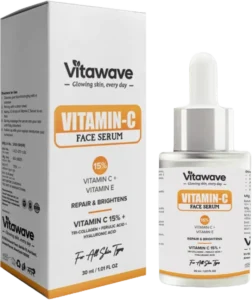
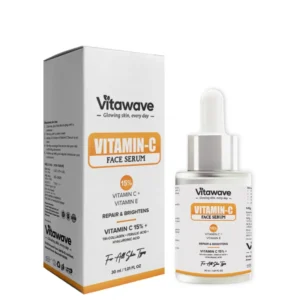
The vitawave 15% Vitamin C Serum with Hyaluronic Acid ticks all these boxes. It’s formulated with Tri-Collagen, Vita C & E, and is water-based — making it ideal for Indian skin across all seasons.
3. How to Apply Vitamin C Serum on Face — Step-by-Step Guide
Here’s the exact process. Follow each step, and you’ll maximise every drop.
Step 1: Cleanse Your Face Thoroughly
Why this matters: Vitamin C serum needs direct contact with your skin to penetrate effectively. Dirt, oil, pollution residue, and even leftover makeup create a barrier that prevents absorption.
How to do it:
- Use a gentle, pH-balanced cleanser (avoid harsh soaps — they strip your skin’s natural barrier)
- If it’s evening, consider double cleansing — first with a micellar water or oil cleanser to remove sunscreen/makeup, then with your regular cleanser
- Wash with lukewarm water (not hot — hot water strips moisture)
- Pat your face dry with a clean, soft towel — don’t rub
Pro tip for Indian climate: If you live in a humid city like Mumbai, Chennai, or Kolkata, you might have excess oil buildup even in the morning. A gentle foaming cleanser works best. In drier climates like Delhi or Rajasthan winters, opt for a cream-based cleanser.
[Add Image Here: Person gently washing face with cleanser, water splashing, clean and fresh look]
Step 2: Apply Toner (Optional but Recommended)
Why this matters: A good toner does two things — it removes any last traces of impurities your cleanser missed, and it rebalances your skin’s pH level. Vitamin C serums work best at a slightly acidic pH (around 3.5), and toner helps create that optimal environment.
How to do it:
- Pour a small amount of alcohol-free toner onto a cotton pad or your palms
- Gently press (don’t swipe aggressively) it across your face and neck
- Wait 30 seconds to 1 minute for it to absorb
Important: Skip toners that contain niacinamide at this step if you’re about to apply Vitamin C. While modern research shows they can be used together, applying them back-to-back at high concentrations can reduce each other’s effectiveness. If you want to use niacinamide, apply it at a different time of day.
Step 3: Apply the Vitamin C Serum
Now, the main event.
How to do it — the right way:
- Take 3-4 drops of serum on your fingertips (not your palm — you’ll waste product in the creases)
- Dot it on your face — one dot on each cheek, one on your forehead, one on your chin, and one on your nose
- Gently press and pat the serum into your skin using your fingertips. Use upward, pressing motions — don’t rub or drag your skin
- Use light, tapping motions — this stimulates microcirculation and helps the serum absorb deeper into the epidermis
- Don’t forget your neck — take 1-2 additional drops and apply to your neck using upward strokes
- Avoid the eye area — the skin around your eyes is thinner and more sensitive. Unless your serum specifically says it’s eye-safe, keep it away from this area
- Wait 1-2 minutes — let the serum absorb fully before moving to the next step. Your skin should feel slightly tacky but not wet

Expert Tip from vitawave Skincare Team: “The biggest mistake we see is people rubbing serum in like it’s a moisturiser. Vitamin C serum is designed to penetrate, not sit on top. Pressing and patting allows the active ingredients to absorb into the deeper layers of your skin where they actually work.”
Step 4: Apply Moisturiser
Why this matters: Moisturiser serves as a sealing layer. It locks in the Vitamin C serum and prevents it from evaporating. It also provides additional hydration, which actually helps Vitamin C work better — hydrated skin absorbs actives more effectively.
How to do it:
- Take a pea-sized amount of moisturiser
- Dot it across your face
- Gently massage in upward circular motions
- Include your neck
Choosing the right moisturiser:
- Oily skin: Lightweight, gel-based, oil-free moisturiser
- Dry skin: Cream-based moisturiser with ceramides or hyaluronic acid
- Combination skin: Gel-cream hybrid formulas
- Sensitive skin: Fragrance-free, minimal ingredient moisturiser
Why this pairing works especially well: The vitawave 15% Vitamin C Serum already contains Hyaluronic Acid, which draws moisture into your skin. When you layer a moisturiser on top, you’re essentially creating a hydration sandwich — moisture pulled in by Hyaluronic Acid, sealed in by the moisturiser.
Step 5: Apply Sunscreen (Morning Routine Only — NON-NEGOTIABLE)
Why this is absolutely critical: Vitamin C is a potent antioxidant that fights free radical damage from UV rays. But here’s what most people don’t realise — Vitamin C also makes your skin slightly more photosensitive during the absorption process. If you skip sunscreen, you’re undoing all the work the serum just did.
In fact, studies show that Vitamin C + Sunscreen together provide up to 4x more UV protection than sunscreen alone. They’re not competing — they’re a team.
How to do it:
- Wait 1-2 minutes after moisturiser
- Apply a broad-spectrum SPF 30 or higher sunscreen
- Use the two-finger rule — squeeze out sunscreen along two fingers (index and middle) for the right amount for your face
- Apply evenly, including ears, jawline, and the back of your neck
- Reapply every 2-3 hours if you’re outdoors
For Indian climate: Choose a sunscreen that’s non-greasy and sweat-resistant. Gel-based or water-based sunscreens work best in humid conditions. Matte-finish sunscreens are great for oily skin types.
[Add Image Here: Infographic showing the complete 5-step routine in order — Cleanse → Tone → Vitamin C Serum → Moisturise → Sunscreen, with small icons for each step]
4. When to Apply Vitamin C Serum — Morning or Night?
This is one of the most Googled questions about Vitamin C serum. And the answer might surprise you.
Morning Application ☀️
Best for: Antioxidant protection, brightening, fighting pollution and UV damage
Why it works: Your skin faces maximum environmental stress during the day — UV rays, pollution, blue light from screens. Vitamin C is a powerful antioxidant that neutralises free radicals in real-time. Applying it in the morning means your skin has active protection throughout the day.
This is especially important in Indian cities where pollution levels are high. Whether you’re commuting in Delhi’s traffic, walking through Mumbai’s humid streets, or sitting in an air-conditioned office in Bangalore — your skin is under attack. Morning Vitamin C is your shield.
Night Application 🌙
Best for: Repair, collagen synthesis, dark spot correction
Why it works: Your skin’s repair cycle peaks between 11 PM and 2 AM. Vitamin C supports collagen production — the protein that keeps your skin firm and plump. Applying it at night means it works alongside your body’s natural healing process.
Night application also means no UV exposure risk during the absorption window.
So Which One Should You Choose?
Our recommendation: Morning.
Here’s why — the antioxidant protection benefits of Vitamin C are most valuable when your skin is actually facing environmental aggressors. At night, your skin isn’t fighting UV or pollution, so the antioxidant function is somewhat wasted.
However, if you have sensitive skin and find that Vitamin C + sunscreen feels too heavy for your skin type, nighttime application is perfectly fine.
The advanced approach: Use it both morning AND night. Start with once daily for the first 2-3 weeks, then increase to twice daily once your skin builds tolerance.
| Morning Application | Night Application | |
|---|---|---|
| Primary Benefit | Antioxidant protection | Repair & collagen boost |
| Must pair with | Sunscreen (mandatory) | Night moisturiser |
| Best for | Pollution-exposed, outdoor lifestyles | Sensitive skin, anti-aging focus |
| Indian climate advantage | UV + pollution defence | Repair from daily damage |
Related Read: Expert Tips for Using Vitamin C Serum — Our skincare experts share advanced application techniques.
5. How to Layer Vitamin C Serum in Your Skincare Routine
The golden rule of skincare layering: thinnest to thickest consistency.
Vitamin C serum is water-based and lightweight, so it goes on early in your routine — after cleansing and toning, but before heavier products.
Morning Routine — Correct Order:
- 🧴 Cleanser
- 💧 Toner
- ✨ Vitamin C Serum ← Here
- 👁️ Eye Cream (if using)
- 🧊 Moisturiser
- ☀️ Sunscreen
Night Routine — Correct Order:
- 🧴 First Cleanse (oil/micellar water)
- 🧴 Second Cleanse (regular cleanser)
- 💧 Toner
- ✨ Vitamin C Serum ← Here
- 🧪 Treatment products (retinol, etc. — see warning below)
- 👁️ Eye Cream
- 🧊 Night Moisturiser/Sleeping Mask
[Add Image Here: Visual pyramid/infographic showing the layering order — thinnest at the base (cleanser, toner, serum) building up to thickest (moisturiser, sunscreen) at the top]
What NOT to Layer with Vitamin C Serum:
| Ingredient | Why to Avoid Layering Together | What to Do Instead |
|---|---|---|
| Retinol/Retinoids | Both are potent actives — together they can cause irritation, redness, and peeling | Use Vitamin C in the morning, Retinol at night |
| AHA/BHA Exfoliants | Can alter the pH environment and reduce Vitamin C effectiveness | Use exfoliants on alternate days |
| Benzoyl Peroxide | Oxidises Vitamin C, making it ineffective | Use at completely different times |
| Niacinamide (high %) | At high concentrations applied back-to-back, may reduce effectiveness of both | Wait 10-15 minutes between them, or use at different times of day |
What WORKS GREAT with Vitamin C Serum:
✅ Hyaluronic Acid — Boosts hydration, helps Vitamin C penetrate deeper
✅ Ferulic Acid — Stabilises Vitamin C, doubles its photoprotection
✅ Vitamin E — Works synergistically with Vitamin C for enhanced antioxidant protection
✅ SPF/Sunscreen — The ultimate power duo
This is exactly why the vitawave Vitamin C Serum with Hyaluronic & Ferulic Acid is formulated the way it is — it already combines these synergistic ingredients in one bottle, so you don’t need to worry about layering them separately.
Related Read: Vitamin C Serum Guide: Stop Making These Costly Mistakes — A deep dive into what to avoid.
6. How Much Vitamin C Serum Should You Use?
This seems simple, but getting it wrong is one of the most common reasons people don’t see results — or experience irritation.
The Right Amount:
3-4 drops for your entire face. That’s it.
Here’s a visual reference:
- 1 drop = roughly the size of a small pea
- 3-4 drops = enough to cover forehead, both cheeks, nose, and chin with thin coverage
- Add 1-2 drops for neck application
Why More Isn’t Better:
Using too much serum doesn’t mean faster results. Your skin can only absorb a certain amount of Vitamin C at a time. Excess product:
- Sits on top of your skin without absorbing
- Can cause stickiness and pilling (when products ball up on your skin)
- Wastes your product (and your money)
- May cause irritation in sensitive skin types
Why Too Little Doesn’t Work:
Using just 1 drop for your whole face means uneven application. Some areas get Vitamin C, others don’t. You’ll see patchy results — or no results at all.
Quick Math — How Long Should One Bottle Last?
A standard 30ml bottle of Vitamin C serum contains roughly 600 drops.
- Using 4 drops daily (morning only) = 150 days = ~5 months
- Using 4 drops twice daily (morning + night) = 75 days = ~2.5 months
That’s excellent value, especially when you consider the vitawave 15% Vitamin C Serum is priced affordably for Indian consumers.
Related Read: Best Vitamin C Serum Under 500 Rupees in India — Honest review and value comparison.
7. How to Apply Vitamin C Serum for Specific Skin Concerns
Different skin concerns require slightly different application approaches. Here’s how to tailor your technique:
For Dark Spots & Hyperpigmentation
The concern: Uneven skin tone, post-acne marks, sun spots, melasma patches
Application technique:
- After applying serum all over your face, take 1 extra drop
- Apply it directly on the dark spots as a targeted treatment
- Gently press it in with your ring finger (it applies the least pressure)
- Be consistent — dark spots didn’t appear overnight, and they won’t disappear overnight either
Expected timeline: 4-8 weeks for visible fading with consistent daily use

Related Read: How to Get Rid of Dark Spots & Hyperpigmentation — The Ultimate Skincare Guide
For Dull, Tired-Looking Skin
The concern: Lack of glow, sallow complexion, skin looks “flat”
Application technique:
- Focus on gentle pressing and patting motions — this stimulates blood flow
- Pay extra attention to the centre of your face (nose, inner cheeks, forehead) — this is where dullness is most visible
- Follow immediately with a Hyaluronic Acid-based moisturiser for the “glass skin” effect
- Morning application is key — you want that glow during the day
Expected timeline: 1-2 weeks for initial brightness; 4 weeks for significant glow
Related Read: How Vitamin C Serum Brings Natural Glow
For Anti-Aging & Fine Lines
The concern: Early wrinkles, loss of firmness, fine lines around eyes and mouth
Application technique:
- Apply serum in upward strokes — always against gravity
- Use gentle pressing motions around fine lines — never drag or pull
- Extend application to your neck and décolletage — these areas show aging first but are often neglected
- Night application is particularly beneficial here, as collagen synthesis peaks during sleep
Expected timeline: 6-12 weeks for visible improvement in skin firmness and fine line reduction
For Oily & Acne-Prone Skin
The concern: Excess oil, breakouts, enlarged pores
Application technique:
- Ensure your serum is water-based (not oil-based) — this won’t clog pores
- Use fewer drops (2-3 instead of 4) — oily skin absorbs actives quickly
- Don’t layer heavy moisturiser on top — use a gel-based, oil-free moisturiser
- Avoid applying directly on active breakouts or open acne — wait for them to heal
Important: Vitamin C is not a direct acne treatment, but it helps with post-acne marks and inflammation. For active acne, consult a dermatologist.
For Sensitive Skin
The concern: Redness, irritation, reactive skin
Application technique:
- Start with every other day — not daily
- Buffer the serum — apply a thin layer of moisturiser first, then the serum on top. This creates a buffer that reduces direct contact with skin while still allowing absorption
- Use 2 drops only initially
- Monitor for any redness or tingling — mild tingling for 1-2 minutes is normal; persistent burning is not
- Gradually increase to daily use over 2-3 weeks
Patch test first: Always apply a small amount behind your ear or on your inner wrist and wait 24 hours before full-face application.
8. Common Mistakes People Make When Applying Vitamin C Serum (And How to Avoid Them)
After years of helping Indian consumers with their skincare routines, the vitawave team has identified the most common application errors. Here’s what to watch out for:
❌ Mistake #1: Applying on Dirty or Wet Skin
The problem: Applying serum on a face that hasn’t been properly cleansed means the Vitamin C is fighting through layers of dirt, oil, and dead skin cells instead of penetrating your skin.
The fix: Always cleanse first. Pat your skin until it’s damp, not dripping wet. Slightly damp skin actually helps absorption — soaking wet skin dilutes the serum.
❌ Mistake #2: Rubbing Instead of Pressing
The problem: Aggressive rubbing creates friction that can irritate skin and actually push the serum off your face instead of into it.
The fix: Always use pressing, patting, and gentle tapping motions. Think of it as “pressing the serum into your skin” rather than “spreading it across your skin.”
❌ Mistake #3: Skipping Sunscreen After Morning Application
The problem: This is the single biggest mistake. Vitamin C fights UV damage, but without sunscreen, your skin is still exposed. And during the absorption window, your skin may be slightly more photosensitive.
The fix: Sunscreen is non-negotiable after morning Vitamin C application. Every single time. No exceptions. Even on cloudy days — up to 80% of UV rays penetrate clouds.
❌ Mistake #4: Using Expired or Oxidised Serum
The problem: Vitamin C serum should be clear, pale yellow, or light gold. If it’s turned dark orange, brown, or has changed smell, it has oxidised and is no longer effective — it may even harm your skin.
The fix: Store your serum in a cool, dark place (a drawer or cabinet — not your bathroom shelf where it gets heat and humidity). Check the colour before every use. A quality serum with stabilising ingredients like Ferulic Acid and Vitamin E (like vitawave’s formula) oxidises much slower.
❌ Mistake #5: Expecting Overnight Results
The problem: Vitamin C works at a cellular level — it inhibits melanin production, stimulates collagen synthesis, and repairs UV damage. These are biological processes that take time.
The fix: Commit to at least 4-6 weeks of consistent daily use before judging results. Take a selfie on Day 1 and compare at Week 4. You’ll be surprised at the difference you didn’t notice day-to-day.
❌ Mistake #6: Mixing with Incompatible Ingredients
The problem: Layering Vitamin C with retinol, AHA/BHA, or benzoyl peroxide at the same time can cause irritation or deactivate the Vitamin C.
The fix: Refer to the layering chart in Section 5 above. When in doubt — separate by time. Vitamin C in the morning, other actives at night.
❌ Mistake #7: Applying Too Close to the Eye Area
The problem: The skin around your eyes is 40% thinner than the rest of your face. Active ingredients like L-Ascorbic Acid can cause stinging, watering, and irritation.
The fix: Keep the serum at least half an inch away from your eyes. If you want antioxidant protection for the eye area, use a dedicated eye cream with a gentler form of Vitamin C.
[Add Image Here: Infographic-style “Do’s and Don’ts” visual — green checkmarks for correct practices, red crosses for mistakes, with simple icons]
Related Read: Vitamin C Serum Guide — Stop Making These Costly Mistakes
9. Special Tips for Indian Skin & Climate
Indian skin has unique characteristics that require specific considerations when using Vitamin C serum. Here’s what you need to know:
Understanding Indian Skin Types (Fitzpatrick Scale III-V)
Most Indians fall between Type III to Type V on the Fitzpatrick Scale, which means:
- Higher melanin content
- More prone to hyperpigmentation and dark spots
- Less prone to sunburn but NOT less prone to sun damage (a common myth)
- Vitamin C is actually more beneficial for these skin types because of its melanin-inhibiting properties
Climate-Specific Tips:
🌧️ Humid Climate (Mumbai, Chennai, Kolkata, Goa)
- Use a water-based Vitamin C serum — oil-based formulas feel heavy and greasy
- Wait a full 2 minutes for absorption before layering moisturiser
- Opt for a gel-based moisturiser on top
- Lightweight sunscreen is essential — heavy creams will make you look oily
🥵 Hot & Dry Climate (Delhi, Rajasthan, Central India)
- Apply serum on damp skin — this helps with absorption in dry conditions
- Follow with a richer moisturiser with Hyaluronic Acid to combat dryness
- Store your serum in a cool place — extreme heat accelerates oxidation
- Consider keeping it in the fridge during peak summer
❄️ Cold & Dry Climate (North India winters, Hill stations)
- Your skin barrier is more compromised in cold weather — start slow if you’re new to Vitamin C
- Layer with a heavier, cream-based moisturiser
- Don’t skip sunscreen — winter UV is still damaging, especially at higher altitudes
🏙️ High-Pollution Cities (Delhi NCR, Kanpur, Lucknow)
- Morning Vitamin C application is especially important for you
- Pollution generates massive free radical damage — Vitamin C is your first line of defence
- Consider double cleansing in the evening to remove pollutant buildup before night application
Indian Skin-Specific Benefits of Vitamin C:
| Concern | Why It’s Common in Indians | How Vitamin C Helps |
|---|---|---|
| Hyperpigmentation | Higher melanin = more prone to uneven melanin distribution | Inhibits tyrosinase enzyme → reduces excess melanin production |
| Dark spots from acne | Post-inflammatory hyperpigmentation is more visible on Indian skin tones | Fades existing dark spots by regulating melanin |
| Dull skin from pollution | India’s cities have some of the highest pollution levels globally | Neutralises free radicals caused by pollution |
| Uneven skin tone | Sun exposure without adequate protection over years | Brightens and evens out complexion gradually |
| Premature aging | UV exposure + pollution = accelerated skin aging | Boosts collagen production and provides photoprotection |
Related Read: Best Vitamin C Serum for Face in India — Curated picks for Indian skin types and climate.
10. How Long Before You See Results?
Let’s set realistic expectations:
The vitawave Results Timeline:
Week 1-2: The Foundation Phase
- Skin feels smoother and more hydrated (thanks to Hyaluronic Acid in the formula)
- Slight improvement in skin texture
- Your skin is adjusting — don’t expect miracles yet
- Some people experience mild tingling — this is normal and subsides as skin builds tolerance
Week 2-4: The Glow Phase
- Noticeable brightness and glow — this is usually the first visible change
- Skin looks more “awake” and “alive”
- Friends might ask if you’ve started a new routine
- Minor dark spots start to fade
Week 4-8: The Transformation Phase
- Significant fading of dark spots and hyperpigmentation
- More even skin tone across face and neck
- Improved skin elasticity and firmness
- Reduced appearance of fine lines
Week 8-12: The Full Results Phase
- Maximum brightening and glow
- Dark spots substantially faded
- Visibly younger, healthier-looking skin
- Improved overall skin health and resilience

Factors That Affect Your Results:
- Consistency — daily application gives faster results than occasional use
- Concentration — 15% L-Ascorbic Acid (like vitawave’s formula) is the evidence-backed sweet spot
- Supporting ingredients — Ferulic Acid and Vitamin E boost Vitamin C’s effectiveness by up to 8x (as per research published in the Journal of Investigative Dermatology)
- Sunscreen use — without sunscreen, UV damage continues to create new dark spots and damage faster than Vitamin C can repair
- Overall lifestyle — adequate water intake, sleep, and diet all support skin health
Related Read: 15% Vitamin C Serum for Daily Brightness — Your Secret to Radiant Skin
11. Which Vitamin C Serum Should You Use?
Now that you know exactly how to apply Vitamin C serum, the question becomes — which one?
Here’s what to look for in a Vitamin C serum that will actually deliver results:
The Non-Negotiable Checklist:
✅ 15% L-Ascorbic Acid — the most researched concentration
✅ Hyaluronic Acid — for deep hydration and better absorption
✅ Ferulic Acid — stabilises Vitamin C and boosts photoprotection
✅ Vitamin E — synergistic antioxidant partner
✅ Water-based formula — lightweight, fast-absorbing, ideal for Indian climate
✅ Dark/opaque packaging — protects from light degradation
✅ Cruelty-free and dermatologist-tested
✅ Made in India — formulated for Indian skin types and climate
Our Recommendation: vitawave 15% Vitamin C Serum
The vitawave 15% Vitamin C Serum with Hyaluronic Acid is formulated specifically to meet every criterion above:
- 15% Vitamin C — optimal concentration
- Hyaluronic Acid — hydrates and plumps
- Tri-Collagen Complex — supports skin firmness
- Vitamin C & E — dual antioxidant protection
- Water-based — no greasy residue
- Dermatologist-recommended and cruelty-free
- Made in India 🇮🇳
It’s designed for all skin types — oily, dry, combination, normal, and even sensitive skin (with the gradual introduction method described in Section 7).
Ready to Start Your Vitamin C Journey?
👉 Buy vitawave 15% Vitamin C Serum — Shop Now on vitawave.in
Also available on Flipkart:
👉 Buy on Flipkart
12. Frequently Asked Questions (FAQs)
Q1: Can I apply Vitamin C serum every day?
Yes, absolutely. Vitamin C serum is safe for daily use. In fact, daily application is recommended for best results. Start with once daily, and if your skin tolerates it well after 2 weeks, you can use it twice daily (morning and night).
Q2: Can I apply Vitamin C serum directly on my face?
Yes, but only on clean skin. Always cleanse and (optionally) tone your face before applying Vitamin C serum. Applying on dirty skin wastes the product because it can’t penetrate through oil, dirt, and pollutants.
Q3: Should I apply Vitamin C serum before or after moisturiser?
Before moisturiser. Vitamin C serum is thinner and lighter than moisturiser. Apply it first so it penetrates your skin directly. Then apply moisturiser on top to seal it in. Think: thinnest to thickest.
Q4: Can I use Vitamin C serum with sunscreen?
Yes — and you should. Vitamin C + sunscreen is the most powerful daytime skin protection combination. Vitamin C provides antioxidant protection from the inside, while sunscreen creates a physical/chemical barrier on the outside. Apply Vitamin C serum first, then moisturiser, then sunscreen as the last step.
Q5: Can I use Vitamin C serum at night?
Yes. While morning application is most popular (for antioxidant protection during the day), nighttime application is also beneficial. At night, Vitamin C supports your skin’s natural repair process and boosts collagen synthesis. If you have sensitive skin, nighttime application might be better for you since there’s no UV exposure risk.
Q6: How long should I wait after applying Vitamin C serum?
Wait 1-2 minutes before applying the next product (moisturiser or sunscreen). This gives the serum enough time to absorb into your skin. Your face should feel slightly tacky but not wet before you move to the next step.
Q7: Can I apply Vitamin C serum on wet skin?
Damp skin is fine; soaking wet is not. Slightly damp skin can actually enhance absorption. But if your face is dripping wet, the water will dilute the serum and reduce its concentration on your skin. Pat your face until it’s damp, then apply.
Q8: Can I use Vitamin C serum with retinol?
Yes, but not at the same time. Use Vitamin C in the morning and retinol at night. Applying both together can irritate your skin and reduce the effectiveness of both. Separating them by time of day gives you the benefits of both without the risks.
Q9: Is Vitamin C serum safe for oily/acne-prone skin?
Yes, if you choose the right formula. Look for water-based, oil-free formulas. The vitawave 15% Vitamin C Serum is water-based, making it suitable for oily and acne-prone skin without clogging pores.
Q10: Why does my Vitamin C serum tingle when I apply it?
Mild tingling for 1-2 minutes is normal — it means the active ingredients are working. This is especially common when you first start using the serum. However, if the tingling is severe, lasts longer than 5 minutes, or is accompanied by redness and burning, wash it off and try the buffering method (moisturiser first, then serum).
Q11: Can men use Vitamin C serum? How should they apply it?
Absolutely. The application process is identical for men. However, if you’ve just shaved, wait at least 10-15 minutes before applying the serum — freshly shaved skin has micro-cuts that can sting with active ingredients. Read our complete guide for men here.
Q12: Can I apply Vitamin C serum under my eyes?
Generally, no. The skin around your eyes is very thin and delicate. Most Vitamin C serums (including 15% concentration formulas) are too strong for this area. Use a dedicated eye cream instead. If you accidentally get serum near your eyes and experience stinging, rinse with cool water immediately.
Q13: What happens if I stop using Vitamin C serum?
Your skin won’t “get worse” than it was before, but you’ll gradually lose the protective and brightening benefits. The glow will fade over 4-6 weeks, and without antioxidant protection, your skin will be more vulnerable to environmental damage. Consistency is key for long-term results.
Q14: Can I use Vitamin C serum during pregnancy?
Vitamin C serum is generally considered safe during pregnancy, as it’s a topical antioxidant. However, we always recommend consulting your gynaecologist or dermatologist before adding any new active to your routine during pregnancy.
Q15: How should I store my Vitamin C serum?
In a cool, dark place away from direct sunlight and heat. A bedroom drawer, cabinet, or medicine shelf works well. During Indian summers (especially in North India where temperatures cross 40°C), consider storing it in the refrigerator. Always ensure the cap is tightly closed after every use — air exposure accelerates oxidation.
Quick-Reference Cheat Sheet: How to Apply Vitamin C Serum
Save this or screenshot it for daily reference:
| Step | What to Do | Time |
|---|---|---|
| 1. Cleanse | Gentle cleanser, lukewarm water, pat dry | 1-2 min |
| 2. Tone | Alcohol-free toner, press gently | 30 sec |
| 3. Vitamin C Serum | 3-4 drops, dot on face, press & pat | 1 min + 1-2 min wait |
| 4. Moisturise | Pea-sized amount, upward circular motions | 1 min |
| 5. Sunscreen (AM only) | SPF 30+, two-finger rule, apply generously | 1 min |
Total time: 5-7 minutes. That’s less time than your morning chai takes to brew
Final Thoughts
Applying Vitamin C serum isn’t rocket science. But doing it right — with the correct technique, in the right order, at the right time, with the right complementary products — is the difference between “I don’t see any results” and “my skin has never looked this good.”
Here’s your action plan:
- Get a quality Vitamin C serum with the right concentration, stabilising ingredients, and formulation for Indian skin
- Follow the 5-step routine outlined in this guide
- Be consistent — daily use for at least 4-6 weeks
- Always use sunscreen in the morning
- Be patient — great skin is a journey, not a destination
Your skin deserves the best. Give it the right ingredients, applied the right way, and it will reward you with a natural, radiant glow that no filter can replicate.
Start Your Glow Journey Today ✨
Dermatologist-Recommended | Cruelty-Free | Made in India 🇮🇳
Related Articles You’ll Love:
- Benefits of Vitamin C Serum
- Best Vitamin C Serum for Face in 2026
- How Vitamin C Serum Brings Natural Glow
- Vitamin C Serum for Dark Spots — Why vitawave’s Formula Works
- Best Vitamin C Serum in India
- Magic of Vitamin C Serum
- 10 Home Remedies for Glowing Skin
- Why a 15% Vitamin C Serum is Your Skin’s New Best Friend
Disclaimer: This article is for informational purposes and is based on published dermatological research and our skincare expertise. It is not a substitute for professional medical advice. If you have specific skin conditions or concerns, please consult a qualified dermatologist.
Recent Blogs
-
 Best Vitamin C Face Serum in India 2026
-
 Best Vitamin C Serum for Glowing Skin
-
 The Ultimate Routine: How to Use Vitamin C Serum for Maximum Glow
-
 Vitamin C Serum
-
 How to Apply Vitamin C Serum – Complete Step-by-Step Guide
-
 Best Vitamin C Serum for Face in 2026
-
 Best Vitamin C Serum for Men in 2026
-
 Vitamin C Serum: Benefits, How to Use It, and Why VitaWave 20% Vitamin C Serum is India’s Best Choice in 2026
-
 Benefits of Vitamin C serum
-
 The Best Vitamin C Serum for Face in India